Why should you appoint an independent Lift Consultant?
An independent Lift Consultant helps you get the most out of your Vertical Transportation assets, and out of your Maintenance Provider, and assists in optimising the reliability, performance, safety and longevity of your equipment.
LML Lift Consultants
5
min read
September 24, 2026
The short answer
What does a lift consultant do? An independent Lift Consultant gives independent advice on the performance, maintenance, modernisation, design and safety of Lifts, Escalators, Building Maintenance Units, hoists and other Vertical Transportation systems. The Consultant audits the equipment, manages Maintenance Agreements and Maintenance Providers, plans and manages modernisation and replacement projects, and advises Owners of plant, based on what is best for the property and without selling equipment.
If you manage property, Lifts are just one item on your 'to do' list. They typically only get attention when something goes wrong: a breakdown, a passenger entrapment, a surprise invoice, or a tenant complaint.
Across a larger portfolio, any reactive responses, along with the failure to plan, can become expensive quickly. Different buildings utilise different Lift Contractors, types of equipment and Maintenance Agreements, and nobody has the time to check whether the equipment or Maintenance Provider is performing at an acceptable standard.
Modernisation and replacement of Lifts, Escalators and moving walks is expensive, and it calls for help from industry specialists who keep the building's and the Owner's needs front of mind, rather than a contractor selling to suit its own product lines.
Some Owners and Facilities Managers engage the services of independent Lift Consultants to manage entire Vertical Transportation portfolios. This article covers what that involves and how this may benefit your building.
Signs you need help
Check how many of these apply to your portfolio:
Three or more?
If three or more of these apply, independent management is likely to pay for itself.
You manage several buildings with Lifts or Escalators from different manufacturers, being maintained by various Lift Contractors
Nobody in your team has Vertical Transportation expertise, so advice is being provided by the Lift Contractor and goes unchallenged
Breakdowns keep recurring on the same equipment
Extra invoices are received for works which you thought were covered under the terms and conditions of the Maintenance Agreement in place
Contracts expire, or automatically 'roll over' without anyone first reviewing
You hold modernisation proposals from several suppliers, none of them like for like, so you cannot compare them
Your contractor has advised that your controller or variable frequency drive is obsolete and no longer supported
Capital costs surprise you, because no forecasting has been implemented in relation to when equipment is likely to need upgrading or replacing
What an independent consultant does
A portfolio management service typically covers:
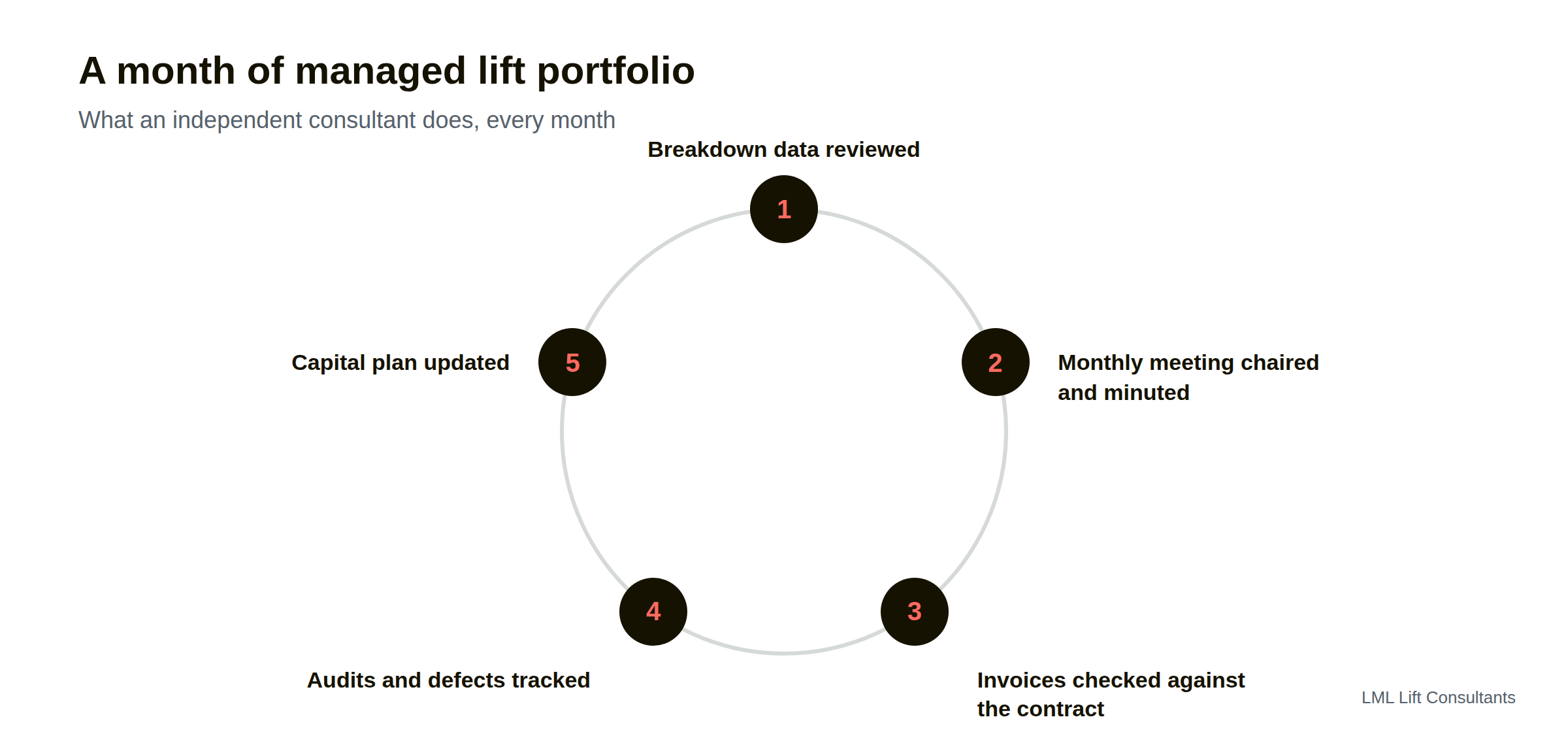
Monthly meetings with each Maintenance Provider, chaired by the consultant, with minutes issued
Breakdown review: the number of callbacks recorded, their causes and trends, discussed with the contractor
Invoice checking: confirming whether extra charges really fall outside the contract in place
Regular maintenance and condition audits of every Lift and Escalator, including testing of safety features and performance analysis, with defects tracked to completion
Project Management of repair works, modernisation or replacement projects
Methodology reports on how to replace or modernise equipment with the least disruption to the building
Capital planning: forecasting when equipment will need upgrading, and what it will cost
An advice line for day-to-day questions
The Consultant deals directly with the Lift Contractor and handles the detail on your behalf, with you receiving a report.
Meetings don't have to be in person. Since 2020, LML has also run portfolio management remotely, with monthly meetings online, for Clients who prefer it, or when sites are remote or spread across states. Remote Clients get the same breakdown reviews and invoice checks.
The case for engaging a Lift Consultant
Lift Contractors are held to account. They perform differently when someone who understands the equipment reviews their work every month.
Fewer costs come as a surprise, because invoices are regularly checked, obsolescence claims are tested and capital needs are forecast years in advance.
The hours your team spends chasing Lift Contractors go into other work.
Better Maintenance Agreements: renewals are managed, and new Agreements include service levels the contractor must meet.
450+
building sites under LML advisory
The case against
A single building with one reliable lift may not need ongoing management. An annual audit and a contract review at renewal may be enough.
If your team already has lift expertise and the time to use it, a consultant adds less.
Management is an ongoing cost, so it should pay for itself through avoided invoices, fewer breakdowns and longer equipment life. If it doesn't, it isn't worth paying for. On one owners corporation's three lifts, regular meetings with the maintenance provider and an audit each year took a heavy first-year list of defects and breakdowns down to no callouts by the third year.
What to look for in a consultant
Hands-on industry experience: consultants who have maintained, installed and modernised lifts know where problems hide.
Experience across every brand, since your portfolio probably includes KONE, Otis, Schindler, TK Elevator and smaller brands.
Independence: the consultant should not sell equipment or take commissions from contractors.
Clear reporting that you can pass straight to owners or committees.
The qualities to insist on: ethical, independent, experienced, technically competent, objective, safety focused, commercially aware and accountable.
At LML, we tell you what you need to hear, not what you may want to hear.
Who we manage portfolios for
LML independently manages lift portfolios across commercial and residential property, transport infrastructure, shopping centres and major health networks.
Questions people ask
What does a lift consultant do?
An independent lift consultant audits lifts and escalators, manages maintenance contracts and contractors, plans and manages modernisations, and advises owners, all without selling equipment.
Is a lift consultant worth it for a small building?
Often not for ongoing management. A single building usually benefits most from an annual audit and a contract review at renewal.
Can portfolio management be done remotely?
Yes. Meetings, reporting and invoice checks can be done online, with site visits for audits.
Talk to us about portfolio management
LML Lift Consultants has more than 450 building sites and 1,700 lifts and escalators under advisory, for clients in commercial and residential property, shopping centres, transport and health. We work on every major brand of lift and alongside every lift company in the market, but we sell no equipment and take no commissions.
{"@context":"https://schema.org","@graph":[{"@type":"Article","@id":"https://www.lmlliftconsultants.com.au/insights/lift-management-consultant#article","headline":"Why should you appoint an independent Lift Consultant?","description":"An independent Lift Consultant helps you get the most out of your Vertical Transportation assets, and out of your Maintenance Provider, and assists in optimising the reliability, performance, safety and longevity of your equipment.","image":"https://cdn.prod.website-files.com/6a7fb1da29c27a176bd73b52/6ab1c725c285e44560268c1c_qYdVdcuE.png","datePublished":"2026-09-24T04:15:00.000Z","dateModified":"2026-09-24T04:15:00.000Z","author":{"@id":"https://www.lmlliftconsultants.com.au/#organisation"},"publisher":{"@id":"https://www.lmlliftconsultants.com.au/#organisation"},"mainEntityOfPage":{"@id":"https://www.lmlliftconsultants.com.au/insights/lift-management-consultant#webpage"},"inLanguage":"en-AU"},{"@type":"WebPage","@id":"https://www.lmlliftconsultants.com.au/insights/lift-management-consultant#webpage","url":"https://www.lmlliftconsultants.com.au/insights/lift-management-consultant","name":"Why Appoint an Independent Lift Consultant? | LML","isPartOf":{"@id":"https://www.lmlliftconsultants.com.au/#website"},"breadcrumb":{"@id":"https://www.lmlliftconsultants.com.au/insights/lift-management-consultant#breadcrumb"},"primaryImageOfPage":"https://cdn.prod.website-files.com/6a7fb1da29c27a176bd73b52/6ab1c725c285e44560268c1c_qYdVdcuE.png","inLanguage":"en-AU"},{"@type":"BreadcrumbList","@id":"https://www.lmlliftconsultants.com.au/insights/lift-management-consultant#breadcrumb","itemListElement":[{"@type":"ListItem","position":1,"name":"Home","item":"https://www.lmlliftconsultants.com.au/"},{"@type":"ListItem","position":2,"name":"Insights","item":"https://www.lmlliftconsultants.com.au/insights"},{"@type":"ListItem","position":3,"name":"Why should you appoint an independent Lift Consultant?"}]}]}
Get an independent view before you decide
We sell no equipment and take no commissions. Tell us about your building and a consultant will come back to you.