Basic Lift and Escalator Training
A general working knowledge of vertical transportation, covering lifts, escalators and moving walks, for the people who have to manage these assets. Training runs at our Rowville facility using in-house equipment displays: destination control simulators, emergency communication systems, and fully operational lift and door systems. Participants leave understanding how the equipment behaves, not only the theory.
Enquire about training
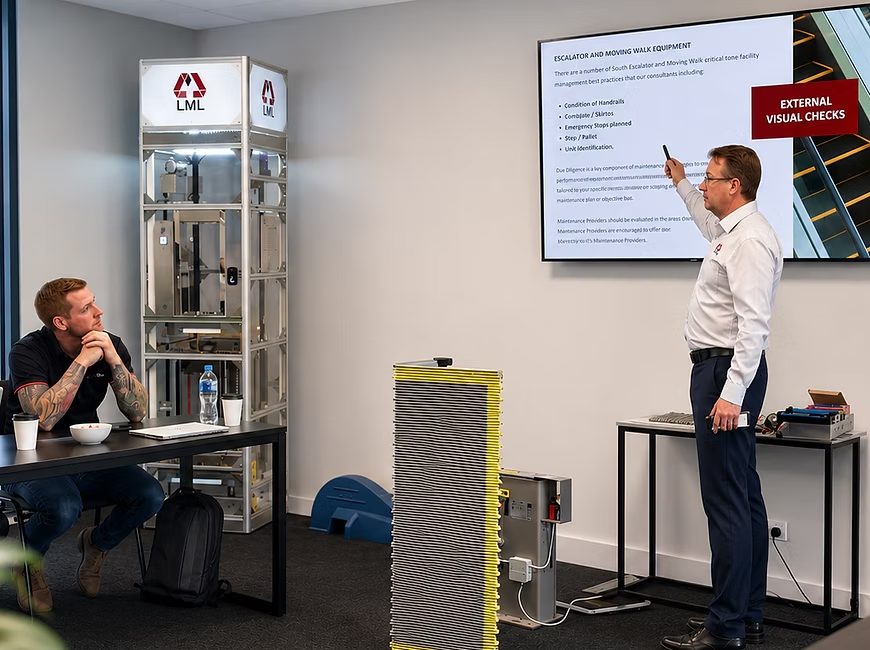
A session in progress at Rowville, with working cutaway equipment alongside practical instruction.
Who it's for
Understand what your maintenance contractor is actually doing, what good looks like, and which faults signal a deeper problem.
Make informed decisions on maintenance agreements, condition reports and capital works without relying solely on supplier advice.
See where lift performance affects tenant satisfaction, operating cost and asset value across a portfolio.
Get grounded in vertical transportation before specifying, tendering or managing an upgrade or new installation.
What you'll cover
Lift terms, types, componentry and operation
Principal components of escalators and moving walks
Callout management: call back types, service and repair records, and the compliance requirements attaching to them
Considerations for vertical transportation upgrade or replacement
Audits and agreements: common findings and failures
Sessions are always interactive and can be tailored to your organisation. Training is delivered with Vertical Ambition and is suited to facility managers, owners corporation managers and building managers responsible for vertical transportation. Tell us your portfolio and experience level and we will shape the content around it.
Common questions
A defensible agreement defines scope and exclusions explicitly, sets separate response times for breakdowns and entrapments, specifies preventative maintenance frequency and the tasks in each visit, names which components are covered and which are charged as extras, and states how performance is measured and what happens when it is not met.
Most disputes we review are not about whether work was done but about whether the contract required it. Vague scope, silent exclusions, uncapped escalation and automatic roll-over provisions are common and are almost always resolvable at renewal, but only if they are identified before the agreement is signed.
Measure five things: attendance against the scheduled preventative maintenance program, callback frequency and repeat faults on the same unit, response times against the times in your contract, defect close-out rates, and the proportion of attendances that are reactive rather than scheduled.
Each is verifiable from records the contractor already produces. Records only take you so far, though. Some of the defects that matter most never present as a fault: ropes that are not being lubricated, for example, will corrode and rouge quietly for years, and the problem surfaces on physical inspection long before it would ever be visible to a building owner. Measuring the paperwork and inspecting the equipment belong together.
On most installations the largest single source of breakdowns is the doors and door operator, followed by control system faults and worn components approaching end of life.
Recurring faults are diagnostic. A unit that fails repeatedly in the same way is usually telling you either that a component is at end of life and is being repeatedly reset rather than replaced, or that a maintenance task is not being performed. Reviewing the fault history alongside the maintenance records and a physical inspection will normally identify which.
Whatever time you are prepared to have a resident wait. The response time in your maintenance agreement is what actually governs how quickly someone is released. Entrapment response should be specified separately from general breakdown response, and most agreements we review do not separate them.
If your agreement sets a single response time covering everything from a stopped lift to a person trapped in a car, you have no distinct entrapment commitment to enforce. The fix is straightforward and is best made at renewal: a separate entrapment response time, a defined measurement point, and a stated consequence when it is not met.
Training runs at our purpose-built centre at Rowville, Victoria, and can be arranged for individual teams, owners corporation committees or portfolio groups.